
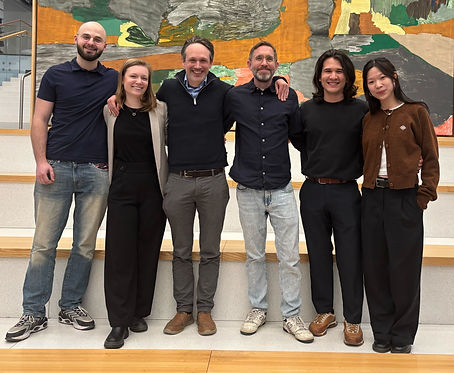
Meet our team

Group leader
Kasper Karlsson
Kasper Karlsson received his PhD from Karolinska Institutet under the supervision of professor Sten Linnarsson. During his doctoral studies, he developed unique molecular identifier (UMI)–based strategies to improve molecular quantification, with applications in non-invasive prenatal diagnostics and single-cell RNA sequencing. Dr Karlsson subsequently carried out his postdoctoral training jointly with professor Christina Curtis and professor Calvin Kuo at Stanford University. During this period, he developed experimental approaches to study early tumor evolution using organoid models, and pioneered expressed cell barcoding systems to track clonal dynamics. Dr Karlsson is currently an Assistant Professor at Karolinska Institutet and a group leader at SciLifeLab. His research focuses on adapting and developing new experimental and computational methods for translational cancer research.

Post doctoral researcher
Lionel
I’m Lionel, a PULSE Postdoctoral Research Fellow in the Karlsson Lab at SciLifeLab and Karolinska Institutet. My work focuses on developing nucleic acid–based therapies for high-risk neuroblastoma, and I’m especially excited about finding smarter, more targeted ways to use oligonucleotide therapeutics and DNA nanostructures. A big part of my research is understanding how to improve tumor targeting while reducing off-target organ uptake and making these treatments safer, more effective, and a step closer to the clinic. I really enjoy the challenge of taking complex molecular ideas and shaping them into something that might one day help patients, and I’m also passionate about connecting fundamental science with clinical translation and future biotech innovation. Before moving to Stockholm, I completed my PhD in Medicine and Health at the University of Sydney in Australia, where I worked on therapy resistance, cancer stemness, and tumor plasticity across multiple solid tumors. I’ve always gravitated toward advanced model systems —especially patient-derived organoids—because they bring us closer to understanding tumor heterogeneity and the functional roles of different cell populations. I find it incredibly rewarding to piece together how these diverse cell clusters contribute to treatment resistance and how we can target them more precisely. Outside the lab, I love travelling, exploring new places, and anything food-related, whether it’s a café, a street-food stall, or a dish I’ve never heard of, I’m always up for trying something new. I enjoy discovering different cultures through their food, their cities, and the small everyday details that make each place unique —and these experiences always bring fresh inspiration and perspectives back into my work.

PhD student
Se Whee Sammy Park
Se Whee (Sammy) Park is a PhD candidate in the Kasper Karlsson lab at Karolinska Institutet. In her doctoral work, Sammy focuses on high-throughput radiosensitization screening and the development of radiopharmaceutical therapies, with particular emphasis on identifying compounds and targets that enhance the efficacy of radiation and radionuclide-based treatments. Her research integrates advanced in vitro tumor models, including tumoroids and organoid systems, with large-scale screening platforms to systematically evaluate treatment responses. By combining experimental rigor with translational relevance, her work aims to improve therapeutic strategies for aggressive cancers and support the development of more effective combination treatments. Sammy has been a core member of the Karlsson lab since its early establishment and plays a central role in driving its experimental research programs.

PhD student
Cheng-de (Ernest) Liu
I am Ernest Cheng-De Liu, a PhD candidate in the Kasper Karlsson lab at Karolinska Institutet. I received my Bachelor's degree in Pharmacy and my Master's degree in Bioinformatics from Shanghai Jiao Tong University. During my Master's project, I focused on predicting drug synergy using deep learning models applied to multi-omics data. In my current doctoral research, I concentrate on measuring heterogeneity and induction using single-cell RNA sequencing data, as well as developing deep learning models to predict drug response at the tumor sub-clone level. My primary research interest lies in the integration and modeling of multiomics data to uncover novel insights in cancer biology and therapeutic strategies.

PhD student
Myra Almén
My name is Myra, and I am the research assistant of the lab. Having finished my Bachelor of Biomedicine and Master's in Molecular Medicine at Uppsala Unversity, I now work together with Sammy on identifying and validating new radiosensitizers for neuroblastoma and rhabdomyosarcoma. Additionally, I am also investigating patient derived pediatric tumoroids by applying spatial technologies such as Visium HD in different settings to learn more about their transcriptional profile in a high resolution spatial setting. Soon I will also be starting as a PhD candidate, where I will continue to apply spatial technologies and combine them with approaches such as single cell sequencing to investigate neuroblastoma differentiation with the goal to improve the use of differentiation therapy in the clinic.

PhD student
Krzysztof Wierbiłowicz
My name is Krzysztof, and I am currently a PhD student in the Karlsson group. I earned both my bachelor’s and master’s degrees in Biotechnology from the University of Gdańsk. During my master’s studies, I investigated genomic aberrations associated with BRCA1 gene loss in prostate cancer. I continued working on prostate cancer during the Fulbright Biolab program at the University of Virginia, where I studied the role of PARP7 in androgen signaling. In my doctoral research, I focus on developing treatment strategies for neuroblastoma using patient-derived organoid models. My main project aims to overcome tumor heterogeneity by designing a drug combination strategy that selectively targets distinct cell subpopulations, utilizing cellular barcodes to quantify heterogeneity. Additionally, I am involved in developing DNA origami-based drugs for neuroblastoma and identifying novel cell surface targets for radiopharmaceutical delivery in rhabdomyosarcoma.

PhD student
Kristofer Ågren
I am Kristofer Ågren, a PhD candidate in the Kasper Karlsson Lab at Karolinska Institutet. My PhD research is about using computational models and single-cell data to make precision cancer medicine more effective. I am specifically working with foundation models and deep learning to predict how cells differentiate and respond to treatments in Neuroblastoma, a childhood cancer. Before moving into academia, I spent over 20 years in the business world, mainly focusing on data analytics, product development, and management. I recently decided to follow my passion for using AI in life sciences by transitioning into academic research.

Master student
Shreya
I am Shreya, a Master’s student in the Karlsson lab. Before moving to Sweden, I completed my Bachelor’s degree in Biotechnology Engineering with a minor in Pharmaceutical Engineering. During my Bachelor’s thesis I worked on understanding the non-catalytic functions of dPIP4K in the PI3K pathway using Drosophila Melanogaster as the model organism. I am currently pursuing my Master’s in Biomedicine at Karolinska Institutet. In the lab, I work together with Myra on neuroblastoma differentiation projects using patient-derived organoid models. My work focuses on identifying and characterizing differentiation markers across multiple experimental modalities, including immunofluorescence, minibulk transcriptomics, and single-cell datasets.

Master student
Qianyun Yu
My name is Qianyun Yu, and I am currently a Master student in the Karlsson group. I completed my Bachelor’s degree in Pharmaceutical Science at Shenyang Pharmaceutical University and am now pursuing a Master of Medical Science in Translational Physiology and Pharmacology at Karolinska Institutet. I now work with Krzysztof on a precision lethality project focusing on identifying and optimizing drug combinations that can eliminate cell populations surviving standard of care chemotherapy in rhabdomyosarcoma. I utilize organoid models and cellular barcoding to characterize treatment-resistant subclones and evaluate how different drug combinations can effectively overcome tumor heterogeneity.